
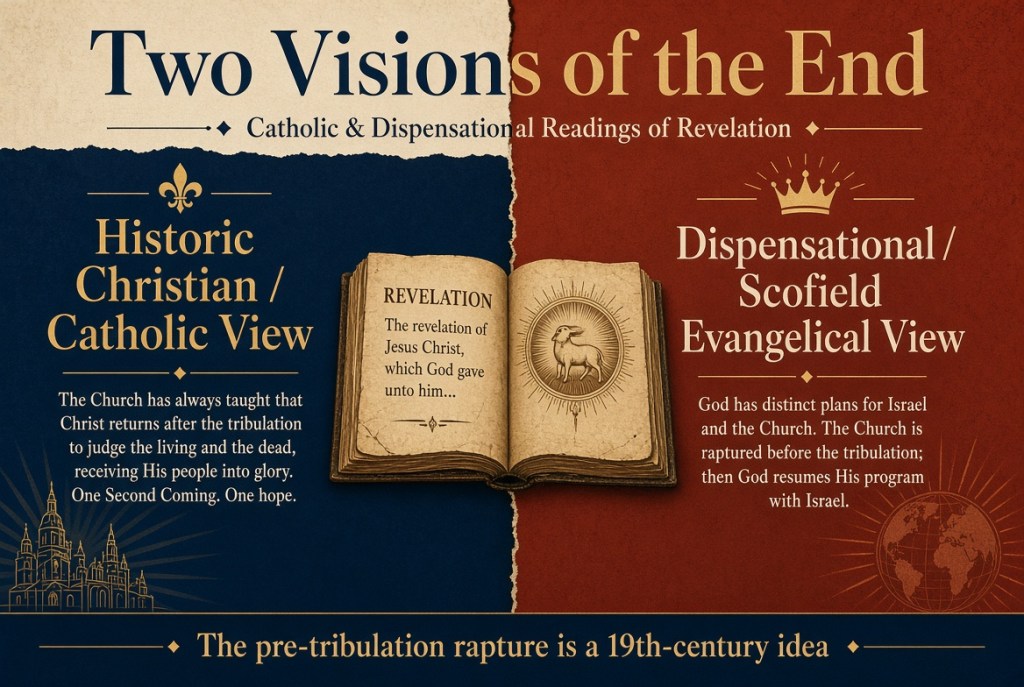
A long-form look at Darby, Scofield, and the two very different ways Christians have read the Book of Revelation
Many evangelical churches teach the pre-tribulation rapture, a future seven-year tribulation, a rebuilt temple in Jerusalem, and a literal thousand-year earthly kingdom as if these were simply “what the Bible says” and “what Christians have always believed.” They are not. The fully developed system that includes a secret pre-tribulation rapture and a sharp distinction between Israel and the Church is a 19th-century development. At the same time, the Catholic Church (and the majority of the historic Christian tradition) reads the Book of Revelation in a markedly different way from the dispensational system popularized by the Scofield Reference Bible. The differences are not minor. They affect how one understands the Antichrist, the mark of the beast, the millennium, the role of modern Israel, and the mission of the Church.
Where the Pre-Tribulation Rapture Came From
John Nelson Darby (1800–1882), an Anglo-Irish clergyman who left the Church of Ireland and became a leader among the Plymouth Brethren, developed the distinctive system in the late 1820s and 1830s. He taught a sharp separation between God’s program for Israel and God’s program for the Church. From that separation he concluded that the Church would be removed from the earth before God resumed His dealings with Israel in a future tribulation. Christ’s return, in this view, occurs in two stages: a secret rapture of the Church, followed later by a visible Second Coming after the tribulation.
This outline was popularized in the United States by the Scofield Reference Bible (first published 1909, revised 1917). Scofield’s notes sat directly beside the King James text and presented seven dispensations, a clear Israel/Church distinction, a pre-tribulation rapture, and a future earthly millennium centered on national Israel. Millions of copies were sold. For generations of American evangelicals, the notes became the default lens for reading prophecy. Later books and the Left Behind series carried the same framework to a mass audience.
For roughly the first 1,800 years of Christian history, the dominant expectation was different. Early writers such as Irenaeus, Hippolytus, and Tertullian anticipated that the Church would face the Antichrist and tribulation. They spoke of believers being gathered to Christ at His visible return. After Augustine, the majority Western view became amillennial: the “thousand years” of Revelation 20 was understood as the present age of the Church. What did not exist as a widely held, systematically taught doctrine was the pre-tribulation rapture as a distinct event that ends the Church age and clears the way for a separate future program focused on ethnic Israel.
How the Catholic Church Reads Revelation
The Catholic Church does not require one single method of interpreting Revelation. Preterist, idealist, historicist, and moderate futurist readings are all held by Catholics in good standing. Certain positions, however, are firm and are stated in the Catechism of the Catholic Church (especially paragraphs 668–677).
Christ already reigns through the Church. The kingdom is present in mystery. The Church rejects millenarianism—even modified forms that expect the messianic hope to be realized within history through a political or earthly kingdom (CCC 676). The “thousand years” of Revelation 20 is understood symbolically as the present Church age (following St. Augustine). Satan is restrained so the Gospel can go to the nations. Before Christ’s return the Church will pass through a final trial involving the Antichrist—a supreme religious deception in which man glorifies himself in place of God (CCC 675). There is one people of God. The full inclusion of the Jews follows the full number of the Gentiles. There is not a separate national political program for ethnic Israel.
Most contemporary Catholic scholars and teachers read the book with strong attention to its first-century historical setting. It was written as resistance literature for Christians facing Roman persecution. Babylon is primarily pagan Rome (the city on seven hills). The Beast is the Roman imperial system or a specific emperor. The seals, trumpets, and bowls are symbolic judgments largely referring to first-century tribulations and the ongoing spiritual battle. The 144,000 is a symbolic number representing the fullness of God’s people. The final consummation—Second Coming, general resurrection, Last Judgment, New Heaven and New Earth—remains future.
The Dispensational/Scofield Reading
Dispensationalism insists on a literal interpretation of prophecy, especially regarding Israel. It maintains a sharp distinction between Israel and the Church as two peoples with separate programs. The Church is viewed as a parenthesis in God’s plan. A pre-tribulation rapture removes the Church before a seven-year tribulation. During that tribulation there is a rebuilt Temple in Jerusalem, a seven-year covenant with the Antichrist, and national conversion of ethnic Israel. Revelation’s structure is read as chapters 1–3 addressing the Church age, with chapter 4 onward (after the rapture) describing the future tribulation, Second Coming, and literal thousand-year earthly reign of Christ from Jerusalem.
In this system the Beast is a future revived Roman Empire led by the Antichrist. Babylon is often an apostate religious system or future one-world religious and commercial power. The 144,000 are literal Jewish evangelists sealed during the tribulation. The woman of Revelation 12 is primarily Israel, protected in the wilderness. The millennium is a literal 1,000-year earthly reign in which Old Testament prophecies of peace are fulfilled politically. The Antichrist is a specific future individual who breaks a seven-year treaty with Israel at the midpoint, sits in the rebuilt Temple claiming to be God, and is destroyed at Christ’s visible return.
Side-by-Side on Key Themes
The Millennium (Revelation 20)
Catholic/traditional: Symbolic of the present Church age. Christ reigns now through the Church. Satan is restrained. No future earthly political kingdom.
Dispensational: Literal future 1,000 years after the Second Coming. Satan physically bound. Christ reigns politically from Jerusalem.
Israel and the Church
Catholic/traditional: One people of God. The Church is the fulfillment and continuation of Israel.
Dispensational: Two distinct peoples with separate programs. The Church is a parenthesis; Israel has a future national restoration.
The Antichrist
Catholic/traditional: A future figure of supreme religious deception (CCC 675). The spirit of antichrist is already active in history. Not primarily a political Middle-East scenario.
Dispensational: A specific future political ruler who makes a seven-year covenant with Israel, breaks it, and claims to be God in a rebuilt Temple.
Babylon and the Beast
Catholic/traditional: Primarily first-century Rome (or, in some preterist readings, apostate Jerusalem). Symbolic of worldly power opposed to God.
Dispensational: Future revived Roman Empire and a one-world religious system, often linked to a coming Antichrist.
The Mark of the Beast (Revelation 13:16–18)
Catholic/traditional: A symbol of allegiance to the Beast (Roman imperial power or the spirit of antichrist). Not a literal future technology. In the first-century context, pressure to participate in the imperial cult could restrict commercial life. The mark is the counterpart to the seal of God on the faithful—both are symbols of whose side one belongs to. The economic exclusion describes the real cost of refusing ultimate loyalty to worldly power.
Dispensational: A literal future mark (often imagined as a chip, tattoo, or biometric ID) required for buying and selling during the seven-year tribulation. Taking it is an irreversible act of worshiping the Antichrist.
The Number 666
Revelation 13:18 invites the reader to “calculate the number of the beast, for it is the number of a man.” In the ancient world this was a familiar practice. Greek and Hebrew had no separate numerals; letters were the numbers. Adding up the value of a name (gematria in Hebrew, isopsephy in Greek) was common in graffiti, political jokes, and coded references. When the Greek form of the emperor’s name and title (“Neron Kaisar”) is written in Hebrew letters, the values total exactly 666. Some early manuscripts read 616 instead of 666. Greek spelled the name “Neron”; Latin spelled it “Nero.” Dropping the final Hebrew letter Nun (worth 50) to match the shorter Latin form produces 616. The same man, two ordinary spellings, both numbers that appear in the manuscript tradition. This fits the first-century setting (Nero was the first emperor to systematically persecute Christians) and the popular legend that Nero had not really died and would return. Dispensational readings typically treat 666 as the future mark or identity of a coming Antichrist rather than a first-century calculation.
The 144,000 and the Woman of Revelation 12
Catholic/traditional: 144,000 is symbolic of the complete people of God. The woman is multi-layered—Israel, the Church, and specifically Mary.
Dispensational: 144,000 are literal Jewish males sealed during the tribulation. The woman is primarily Israel protected in the wilderness.
Why the Differences Matter
These are not small variations in emphasis. One system expects a secret removal of the Church before a future tribulation centered on ethnic Israel and a rebuilt temple. The other sees Christ already reigning through the Church, treats much of Revelation as addressing the first-century situation of Roman persecution (while still affirming a future final consummation), and rejects any attempt to realize the kingdom of God through a political earthly millennium within history. One system has shaped large parts of American evangelical prophecy teaching and, through it, aspects of political culture. The other reflects the majority historic Christian reading after the fourth century and is grounded in the Catechism’s explicit rejection of millenarianism.
The pre-tribulation rapture is not the ancient consensus of the Church. It is a 19th-century interpretive framework that was popularized through one highly influential study Bible and then reinforced by prophecy conferences, Bible institutes, and popular media. Christians who have only heard one side deserve to know that other Christians—Catholic, Orthodox, and Protestant—have read the same Scriptures for centuries without concluding that the Church will be secretly removed before a future seven-year tribulation, or that the mark of the beast must be a future technological implant, or that modern political Israel is the central key to biblical prophecy.
The question is not whether Jesus will return. The question is whether the particular sequence taught in many evangelical churches is the ancient faith of the Church or a relatively recent system that has been presented as if it were timeless. The historical record and the long Catholic tradition show that it is the latter.
Discover more from Books by Stacy A. Padula
Subscribe to get the latest posts sent to your email.


You must be logged in to post a comment.