
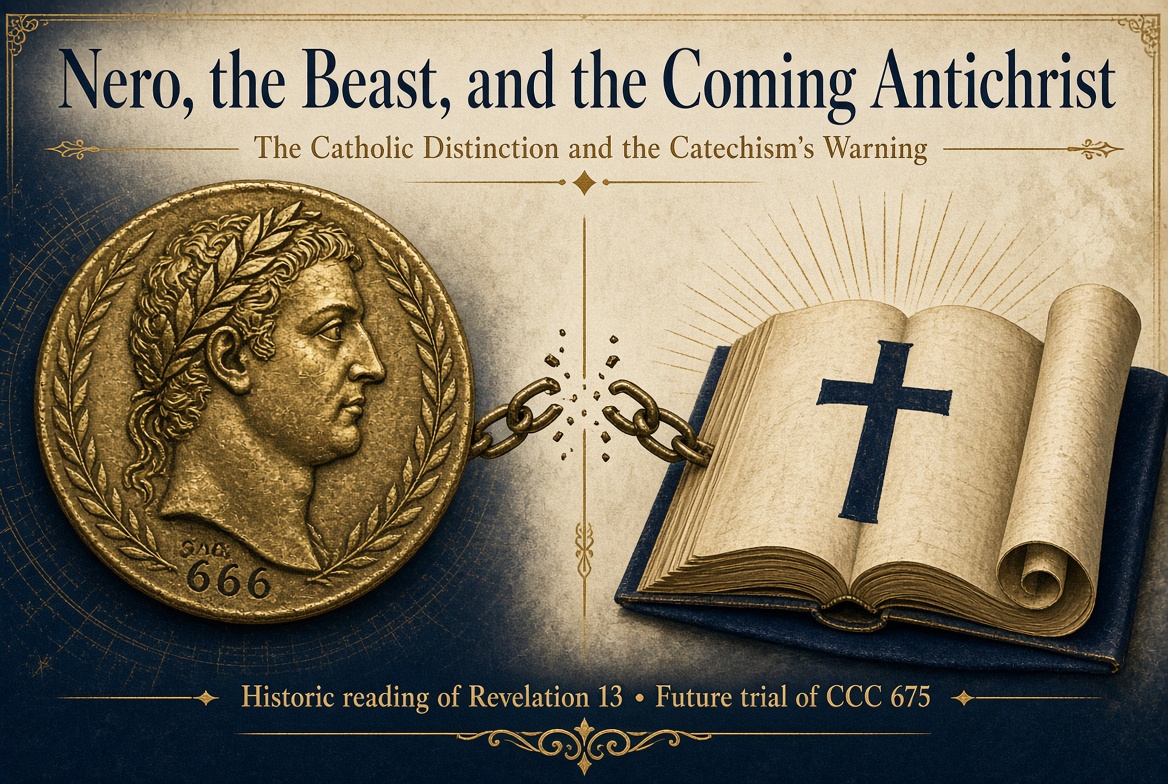
Many people assume the Catholic Church treats the Beast of Revelation and the Antichrist as the same future figure.
It does not.
Catholic teaching and the majority of Catholic biblical scholarship distinguish between the Beast of Revelation 13 (often linked to Nero and first-century Rome) and the future Antichrist described in 2 Thessalonians 2 and the Catechism. Understanding that distinction also clarifies why Catholic tradition views certain modern movements—especially dispensational Christian Zionism—as fitting the pattern of religious deception the Church has long warned against.
The Beast of Revelation and Nero
Revelation 13:18 says: “This calls for wisdom: let the one who has understanding calculate the number of the beast, for it is the number of a man, and his number is 666.” In the first century, calculating the numerical value of a name was a common practice. Hebrew and Greek letters doubled as numbers (gematria or isopsephy). People used it in graffiti, political jokes, and coded references.
When the Greek form of the emperor’s name and title, Neron Kaisar (“Nero Caesar”), is written in Hebrew letters, the values total exactly 666:
- נ (Nun) = 50
- ר (Resh) = 200
- ו (Vav) = 6
- ן (Nun) = 50
- ק (Qof) = 100
- ס (Samekh) = 60
- ר (Resh) = 200
Total: 666.
Some early manuscripts of Revelation read 616 instead of 666. This fits the same identification. Greek spelled the name “Neron”; Latin spelled it “Nero.” Dropping the final Hebrew Nun (worth 50) produces 616. The same man, two ordinary spellings, both numbers that appear in the manuscript tradition.
Nero was the first emperor to systematically persecute Christians. A popular first-century legend claimed he had not really died and would return. Revelation was written as resistance literature for churches under Roman pressure. For these reasons, many Catholic scholars and teachers (along with a broad range of biblical scholars) identify the Beast of Revelation 13 primarily with Nero or the Roman imperial system he represented. This is a historical reading of the text in its original setting. It is not an official dogma that Nero is the only possible referent, but it is the most widely accepted historical solution and the one that best accounts for both the 666 and 616 readings.
The Beast Is Not the Final Antichrist
Catholic teaching distinguishes this from the Antichrist. The Beast of Revelation 13 is understood as a first-century figure or system (Nero/Rome) that can also function as a type or foreshadowing of later opposition to God. The Antichrist, by contrast, refers to a future supreme religious deception before Christ’s Second Coming.
The Catechism of the Catholic Church is explicit:
CCC 675: “Before Christ’s second coming the Church must pass through a final trial that will shake the faith of many believers. The persecution that accompanies her pilgrimage on earth will unveil the ‘mystery of iniquity’ in the form of a religious deception offering men an apparent solution to their problems at the price of apostasy from the truth. The supreme religious deception is that of the Antichrist, a pseudo-messianism by which man glorifies himself in place of God and of his Messiah come in the flesh.”
CCC 676: “The Antichrist’s deception already begins to take shape in the world every time the claim is made to realize within history that messianic hope which can only be realized beyond history through the eschatological judgment. The Church has rejected even modified forms of this falsification of the kingdom to come under the name of millenarianism, especially the ‘intrinsically perverse’ political form of a secular messianism.”
CCC 677: The Church enters the glory of the kingdom only through this final trial, following her Lord in his death and Resurrection. The kingdom is fulfilled by God’s victory over the final unleashing of evil, not by a progressive historical triumph within the present age.
In short, Catholics affirm both of the following:
- The Beast of Revelation 13 has a primary historical referent in Nero and the Roman Empire of the first century.
- There remains a future final trial involving a supreme religious deception—the Antichrist—before Christ’s return. The spirit of antichrist has already been active throughout history (1 John), but it will reach a climactic expression.
The Church does not officially identify who the final Antichrist will be, when he will appear, or what precise form the deception will take. It does describe the essential character of the deception: a pseudo-messianism in which man glorifies himself in place of God, and any attempt to realize the messianic hope within history rather than beyond it through the final judgment.
How Christian Zionism Fits the Catechism’s Description
Dispensational Christian Zionism (the system popularized by John Nelson Darby in the 1830s and the Scofield Reference Bible in the early 20th century) teaches that the modern political State of Israel, a future rebuilt Temple in Jerusalem, and a literal thousand-year earthly kingdom centered on national Israel fulfill biblical messianic promises. In this view, God has a separate ongoing program for ethnic Israel distinct from the Church, and current events in the Middle East are prophetic fulfillments that will culminate in an earthly reign of Christ from Jerusalem.
This is precisely the kind of claim the Catechism identifies as the beginning of the Antichrist’s deception. CCC 676 warns that the deception “already begins to take shape in the world every time the claim is made to realize within history that messianic hope which can only be realized beyond history through the eschatological judgment.” It specifically rejects millenarianism—even in modified forms—and “the intrinsically perverse political form of a secular messianism.”
Christian Zionism relocates the fulfillment of God’s promises from Christ and the Church (the New Israel) to a modern nation-state and a future political kingdom. It treats territorial restoration, a rebuilt Temple, and an earthly millennium as the realization of messianic hope inside history. Catholic teaching holds that those promises are fulfilled in Jesus Christ and the Church, that Christ’s kingdom is already present in mystery, and that any attempt to realize it through a political project within the present age is a falsification of the kingdom to come.
This does not mean the Catholic Church has issued a formal declaration that “Christian Zionism is the Antichrist.” It does mean that the central claims of dispensational Christian Zionism match the criteria the Catechism gives for the kind of religious deception that prepares the way for the final trial. The promises to Abraham are fulfilled in Christ, not in a contemporary political state. The Church is the continuation and fulfillment of Israel. There is no separate national program awaiting a future earthly kingdom. Attempts to locate messianic fulfillment in modern Israel’s political existence or a coming millennial state are, on Catholic terms, a form of the very historical messianism the Church has rejected.
Key Takeaways
- The Beast of Revelation 13 is widely understood in Catholic scholarship as Nero or the Roman imperial system (666 = Neron Kaisar in Hebrew gematria; 616 matches the Latin form). This is a first-century historical reading.
- The Antichrist is a future supreme religious deception—a pseudo-messianism in which man glorifies himself in place of God—before Christ’s Second Coming (CCC 675). The spirit of antichrist is already active; a final climactic expression remains.
- Christian Zionism, by treating a modern political state and a future earthly kingdom as the fulfillment of messianic promises within history, fits the pattern CCC 676 identifies as the beginning of that deception. It is a form of the millenarianism and political messianism the Church rejects.
These are not minor differences of emphasis. They reflect fundamentally different understandings of how God’s promises are fulfilled, what the kingdom of God is, and where Christian hope is properly placed.
The Catholic reading keeps the distinction between the historical Beast of Revelation and the future Antichrist, while warning that any attempt to realize the messianic hope through a political project inside history already participates in the deception the Church expects before the end.
Discover more from Books by Stacy A. Padula
Subscribe to get the latest posts sent to your email.


You must be logged in to post a comment.