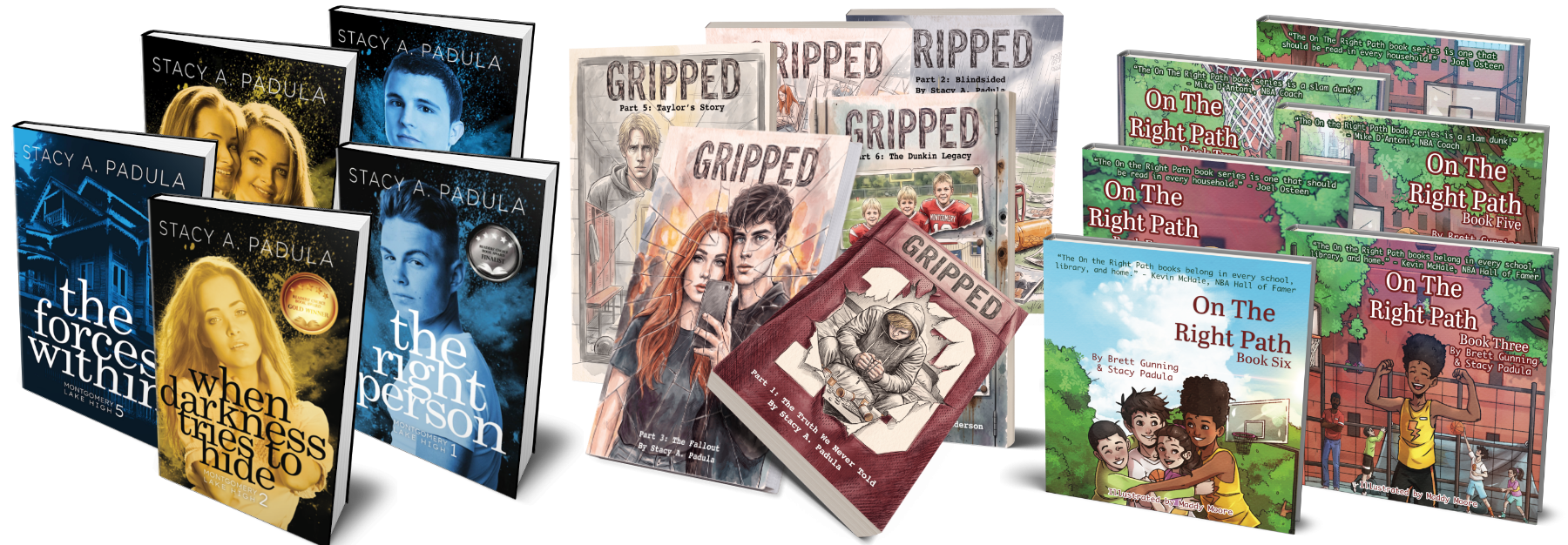










If you’ve spent any time talking with readers of the Gripped series (or the Montgomery Lake High books), you’ve probably noticed something interesting about Cathy Kagelli. People rarely feel neutral about her.
Some readers call her their favorite. Others admit they wanted to shake her. A surprising number say both—depending on which book they were in when you asked.
That range of emotion isn’t accidental. Cathy was written to be complicated, and the way readers respond to her often reveals exactly where they are in the story.
The Two Cathys Readers Meet
Many readers first encounter Cathy in the Montgomery Lake High series. In those books she can come across as cold, guarded, sharp-tongued, and sometimes manipulative. She’s already carrying years of damage, and it shows. If that’s your introduction, it’s easy to dislike her. You see the walls, the distance, the choices that hurt people around her—and you don’t yet know the full weight of what put those walls up.
Then some of those same readers go back and start the Gripped series. Suddenly they’re watching a quiet, intelligent, deeply feeling freshman who is trying hard to do the right thing. She’s protective of her twin sister Chantal to a fault. She’s drawn to Jason Davids because she sees the good in him, not just the party-boy reputation. She’s the girl who gets pulled into a world she never intended to enter, partly out of loyalty, partly out of loneliness, and partly because anxiety and peer pressure are powerful forces when you’re fourteen or fifteen.
The contrast is jarring on purpose. The Cathy of Montgomery Lake High is the same girl—just further down the road. The series asks readers to hold both versions at once: the girl who was once honest and caring, and the young woman whose pain has made her hard to love at times.
How Feelings Shift Across the Gripped Series
Readers who start at the beginning of Gripped tend to move through a predictable emotional arc with Cathy:
Early books
Sympathy runs high. You watch a shy, observant girl (an INFJ through and through) get grounded, isolated, then slowly drawn into Jason’s world. You understand why she starts taking anxiety medication “just to take the edge off.” You root for her when she tries to protect Chantal. A lot of readers feel protective of her here.
The middle books
Frustration often creeps in. Cathy makes choices that are hard to watch. She stays in a relationship that is clearly damaging both of them. She self-medicates. She pushes people away while simultaneously craving connection. Some readers get angry at her for not walking away sooner or for enabling Jason. Others get quiet and uncomfortable because her spiral feels too realistic. This is usually where the strongest mixed feelings surface. You still care about her—you just wish she’d make different decisions.
Later books
Something shifts. You start to see the cost of everything she’s carried. You watch her fight for sobriety, confront the wreckage, try to repair the relationship with Chantal, and begin to figure out who she is outside of being “Jason’s girlfriend” or “the twin who messed up.” The readers who stuck with her often come out the other side feeling a fierce kind of respect. Not because she was perfect, but because she kept getting back up.
Why the Mixed Emotions Matter
Cathy’s story is built on a truth that doesn’t always feel comfortable: people are rarely just one thing.
Addiction doesn’t only happen to “bad” kids. Anxiety can look like arrogance when someone is too overwhelmed to explain themselves. Protecting someone you love can cost you everything if the situation is more complicated than it appears. And redemption is rarely linear. It includes setbacks, stubbornness, and seasons where the person you care about is difficult to like.
Readers bring their own experiences to Cathy. Some see a version of themselves or someone they love. Some see warning signs they wish they’d recognized earlier. Some simply get tired of watching her struggle and want her to “just get it together already.” All of those responses are part of the conversation the books are trying to start.
Cathy is also an INFJ, which means her inner world is rich and her outer presentation can be reserved or even prickly when she’s hurting. A lot of readers (and other characters) mistake that quiet intensity for coldness or superiority. In real life, that misunderstanding happens constantly. Writing her that way was intentional.
The Point of a Character Like Cathy
I didn’t create Cathy so readers would always like her. I created her so readers would see her—really see her—across the full arc of her story.
The girl who starts out trying to do the right thing and ends up in a dark place is the same girl who has to fight her way back. The version of Cathy that feels toxic in one book is carrying wounds that were formed in another. If readers only meet her at her worst, or only at her most vulnerable, they miss the whole picture.
That’s why the emotions shift depending on where you are in the series. The books are asking you to stay with her long enough to understand the why behind the behavior—and then decide what grace, accountability, and hope look like in response.
If you’ve ever felt conflicted about Cathy, you’re not alone. You’re actually right where a lot of careful readers end up. And if the series has done its job, those mixed feelings eventually settle into something deeper than simple like or dislike: a recognition that people are more than their worst chapter, and that the road back is almost never neat.
I’d love to hear where you are with Cathy right now—whether you’re still frustrated, fully rooting for her, or somewhere in the complicated middle. Those conversations are some of my favorite parts of writing this series.
Discover more from Books by Stacy A. Padula
Subscribe to get the latest posts sent to your email.


You must be logged in to post a comment.